
Child Social Work Thesis Emphasizes the Necessity of Hearing Students Voices in Schools
Child Social Work Thesis Emphasizes the Necessity of Hearing Students Voices in Schools
Fatemeh Haghighat, one of the first graduates of the Child and Adolescent Social Work program at the university, defended her thesis titled Development of the Concept of Child-Friendly Primary Schools in Iran, emphasizing the need for transformation in the country's school educational environments.
According to the report from the university's web correspondent, Fatemeh Haghighat, a Master's graduate in Child and Adolescent Social Work, stated: Perhaps at first glance, the question arises: why should we research child-friendly primary schools? We have all experienced school years and know that for a child, school is not just a place for studying. A child spends many hours of the day and a significant portion of their childhood years in school; there, they learn, make friends, interact with others, face success and failure, and a vital part of their personality and outlook on themselves and others is shaped.
Regarding the importance of the primary period, she added: During this stage, children are still in the early years of forming many of their social, emotional, and communicative skills, and the experience they gain from school can influence their perspective on learning, school, themselves, and their relationships with others. A primary school is usually a child's first serious and continuous experience of being in a formal social and educational environment; for this reason, paying attention to the quality of this environment and its alignment with children's needs is of great importance.
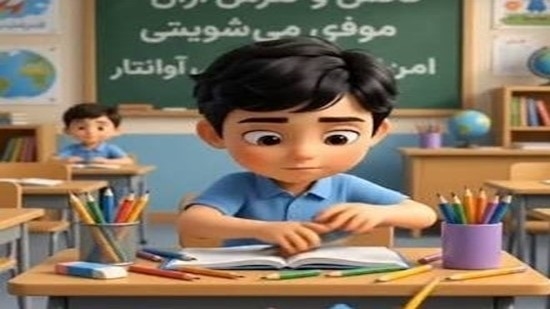
The graduate of Child and Adolescent Social Work said: A child-friendly primary school is a school that does not view the child merely as a student; rather, it recognizes them as a human being with needs, feelings, rights, abilities, and opinions. In such a school, in addition to education, attention is paid to the child's security and mental health, the happiness of the environment, relationships with teachers and classmates, a sense of belonging, the opportunity for participation and having the child's opinion heard, the suitability of the school space to children's needs, and support for both the child and the family.
Fatemeh Haghighat explained her reason for choosing this topic as follows: I felt that in Iran, much has been said about school and the quality of education, but it is necessary for the child themselves and their experience of school to be more seen and heard. Furthermore, many existing models of child-friendly schools have been developed in other countries, and they cannot be applied identically without considering the cultural, social, and educational conditions of Iran.
By listening to the perspectives of children, parents, teachers, principals, counselors, and other school-related individuals, this thesis has answered the question: What characteristics must a primary school in Iran possess to be truly child-friendly? The research results show that being child-friendly is not limited to having a beautiful courtyard or appropriate facilities; rather, it involves a set of interconnected factors—ranging from the physical school space and staff characteristics to teaching and upbringing methods, the way of communicating with parents and children, and counseling services.
She considered hearing the voices of the children themselves to be one of the most important parts of this research, saying: If a school is to be more suitable and friendly for children, it is only logical that the children themselves are seen and heard in defining the characteristics of such a school.
In conclusion, Haghighat viewed the achievement of this thesis not as an end point, but as a cornerstone for a new dialogue within the country's educational system. She stated: The findings of this project should serve as a prelude to changing the perspective of policymakers and educational managers so that Iranian schools, beyond being mere educational spaces, transform into safe, creative, and joyful ecosystems for the flourishing of future generations; an ecosystem where child-centeredness transforms from a slogan into a lived experience for students.

نظر دهید