
The Family Is the First Line of Defense and the Supportive Network for Facing Crises
The Family Is the First Line of Defense and the Supportive Network for Facing Crises
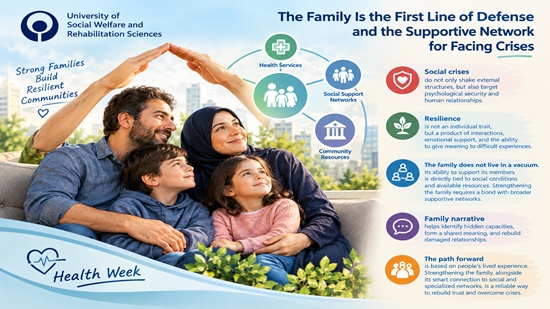
A faculty member of the University of Social Welfare and Rehabilitation Sciences, coinciding with Health Week, stated that social crises, beyond external order, target psychological security and human relationships, considering family resilience not an individual trait but one arising from emotional interactions and the ability to give meaning to difficult experiences, and emphasized the necessity of strengthening the bond between the family and society's supportive networks.
According to the university's web correspondent, Dr. Roza Alikhani, a faculty member of the University of Social Welfare and Rehabilitation Sciences, in analyzing the impact of social crises on people's lives, referring to the slogan of the second day of Health Week titled the family, the first supportive network, stated: Social challenges not only shake external structures, but also target the sense of security and the quality of human relationships, an area that requires more research and specialized intervention.
Resilience: A Product of Interactions and Meaning-Making
This university professor, emphasizing that resilience should not be reduced to merely an individual trait, added: Family resilience is a dynamic concept that forms from within interactions, mutual emotional support, and the ability of members to give meaning to difficult experiences.
Dr. Alikhani, stating that the family does not live in a vacuum, clarified: The family's ability to support its members is directly tied to social conditions and available resources. Therefore, supporting the family is not limited to strengthening in-group relationships; rather, it requires creating a bond between the family and broader supportive networks, health services, and other societal resources.
Family Narrative: The Key to Rebuilding Communications
In another part of her speech, she emphasized the importance of hearing family narratives and said: Narratives are not merely a tool for identifying suffering; rather, they are considered a key way to discover the capacities and abilities hidden within crises. Hearing the different narratives of family members about an event helps in the formation of a shared meaning and ultimately the rebuilding of damaged relationships.
The Necessity of Moving Along the Axis of People's Lived Experience
Dr. Alikhani concluded by noting, regarding the path to achieving a more resilient society: If our goal is to overcome crises and build a cohesive society, we must base our policies and interventions on people's lived experience. Strengthening the family as the first and foremost supportive step, alongside its intelligent connection to social and specialized networks, is a reliable path for rebuilding trust and collectively overcoming social challenges.

نظر دهید